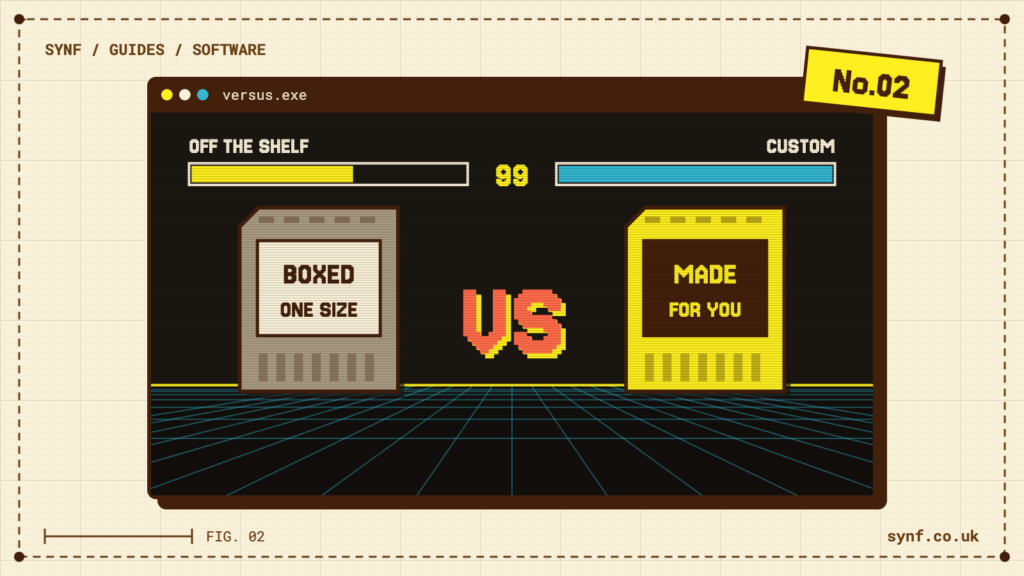
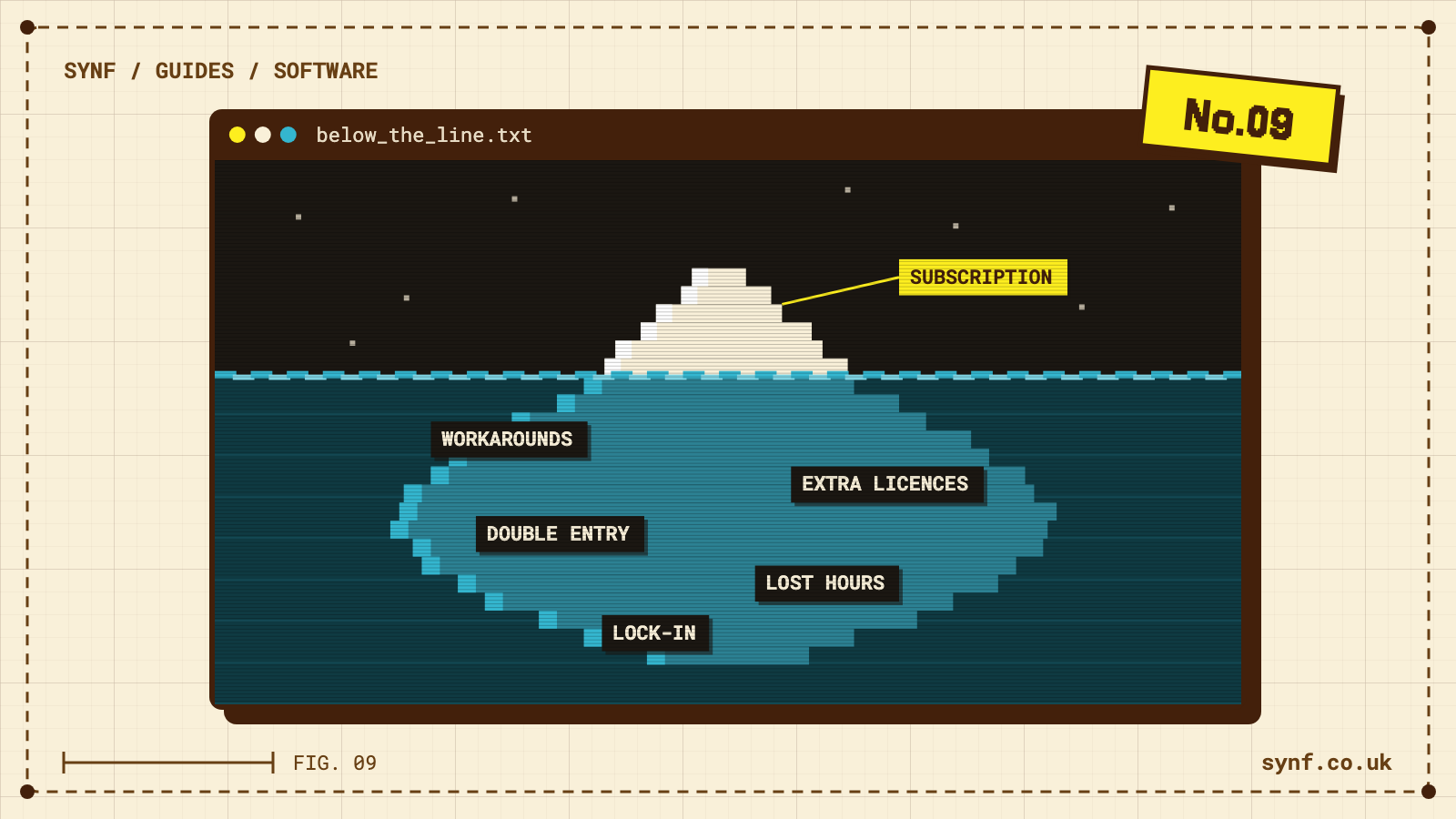
Off-the-shelf software is the right answer for most businesses most of the time. You sign up, pay a monthly fee and get on with your day. The trouble is that it rarely stops being right all at once. It drifts, a workaround here and an extra licence there, until half your team’s week goes on keeping the software happy instead of the other way round.
We’ve written before about the basic choice between custom software and off-the-shelf. This post picks up where that one stops: how to tell when you’ve outgrown a packaged product, and what the bespoke vs off-the-shelf software decision really costs once you count everything, not only the subscription.
When off-the-shelf is still the right call
If your process looks like everyone else’s, buy the product. Accounts, payroll, email, file storage and a basic online shop are solved problems, and tools like Xero or Microsoft 365 handle them better and cheaper than anything you’d commission.
The same goes if you’re early on and still working out how you operate. Building software around a process that changes every month means paying for it twice, so use something cheap and flexible, learn what you actually need, and revisit it later.
And if the package covers 90% of what you do and the other 10% is a minor irritation, live with it. Nobody needs a bespoke build to fix a mildly annoying dropdown.
The costs that don’t show on the invoice
The subscription is the number everyone compares, which is a shame, because it’s usually the smallest cost. The bigger ones sit below the waterline.
What you see on the invoice
What it really costs
- Per-seat fees that grow with you. £25 per user per month feels trivial at four people. At 30 people across three separate tools it comes to about £27,000 a year, and it goes up every time you hire or the supplier reviews its pricing.
- Workarounds. The spreadsheet that fills the gap, the export someone runs every Friday, the customer details copied from one system into another. Each one looks small, but add up the hours and it’s often a part-time job nobody was hired to do.
- Bending your process to fit. When the software expects a job to flow one way and yours flows another, people either change how they work to suit it or quietly stop using it properly. Either way you lose whatever made your way of working good in the first place.
- No ownership. Your data lives on someone else’s platform, in their format, under their terms. If they raise prices, get bought or drop the feature you rely on, your choice is to pay up or start again.
How per-seat licences add up
Yearly licence cost at £25 per user per month. An illustration, so plug in your own numbers.
Signs you’ve outgrown it
The same patterns come up again and again when we talk to businesses who’ve reached that point. Tick the ones that sound like your place.
Tick the ones that sound familiar.
What bespoke changes
Bespoke software is built around how your business already works, so the screens follow your steps and use your words. There’s no per-seat charge climbing as you grow, the data is yours, and when the way you work changes, the software changes with it.
W.M. Montgomery’s work orders used to run on paper. The system we built for them follows the process their team already knew, so nobody had to relearn their job to use it. On another project, a driver app for Long Lane captured exactly what that business needed and nothing else.
There are trade-offs. Bespoke takes longer to get going than a sign-up form, and it’s only as good as the people building it, so choose a partner who asks about your business before they talk about technology and who’ll still be around to support it in a few years.
Side by side
| Off-the-shelf | Bespoke | |
|---|---|---|
| Upfront cost | Low, usually a monthly fee | Higher, or spread monthly (ours start from £150 a month) |
| Time to get going | Same day | Weeks, depending on scope |
| Fit with your process | You adapt to it | Built around it |
| Cost as you grow | Rises with every seat | No per-user fees |
| Your data | On their platform, on their terms | Yours |
| Changes | On their roadmap, if at all | When you need them |
| Best for | Standard jobs like accounts, email and payroll | The part of your business nobody else does quite the same way |
It doesn’t have to be all or nothing
Most businesses we work with keep their off-the-shelf tools for the standard jobs and build bespoke only for the part that’s genuinely theirs. Often that bespoke piece sits in the middle, joining the accounts package to the job sheets and the customer records, so information is entered once and appears everywhere it’s needed. That’s usually what digitisation looks like in practice: fewer tools, properly joined up, instead of replacing everything at once.
Cost is less of a barrier than people expect. Our custom software starts from £150 a month plus a small onboarding fee, which compares well against a stack of per-seat licences. If you want the detail, we’ve broken down what a custom app or business system costs.
Bespoke vs off-the-shelf software: a quick way to decide
If you’re not sure which side of the line you’re on, book a free 15-minute call. We’ll look at what you’re using now and tell you honestly whether to keep it, connect it up or replace it, and if the software you’ve got is fine, we’ll tell you that too.